The 18,000 Square Foot Warehouse: Tear-Off and Total Replacement
The property manager mentioned above ended up with a full tear off. When our crew pulled back a test section of her EPDM, the fiberboard insulation underneath was saturated across roughly 40 percent of the field. Moisture meter readings climbed every time we moved north toward the parapet, which told us the leaks had been migrating under the membrane for years. We walked her through the math: a recover system would have trapped that wet insulation and voided the manufacturer warranty. Tear off was the honest answer.
Her final invoice landed at about $8.40 per square foot, all in. That included tear off and disposal, new polyiso insulation to R-25, a half inch cover board, 60-mil mechanically attached TPO, all flashings, and a 20 year manufacturer warranty. The crew worked in sections so her tenants kept operating below. Total time on the roof was 11 working days, stretched across three weeks because of two rain delays. If you are looking at a similar building and want to understand how we sequence work like this, our writeup on commercial roof replacement timelines covers the planning side in more depth.
One detail worth mentioning from that job: she had a row of HVAC units that her mechanical contractor needed to lift and reset so we could properly flash the new curbs. That coordination added about $4,200 to her overall project, but skipping it would have meant wrapping new TPO around old, corroded curb metal. Five years from now, that shortcut would have been her first leak. We see this pattern often, where owners trying to save a few thousand on adjacent trades end up paying double when the roof fails early at those exact points.
The Strip Center Recover: When Tear-Off Is Not Needed
A different call, same month. The owner of a six tenant strip center in Knightstown had a 15 year old TPO roof that was chalky on the surface but structurally sound. No saturation, no soft spots, no failed seams beyond what a normal repair would handle. He assumed he needed a full replacement and was bracing for a six figure bill.
We core sampled in five locations and found dry insulation throughout. That changed the conversation entirely. He qualified for a recover, meaning we installed a new layer of cover board and 60-mil TPO directly over the existing system. His cost came in at $5.90 per square foot, roughly 30 percent less than a tear off would have been. The crew finished in seven days. He kept his tenants happy, his budget intact, and got a fresh 20 year warranty out of it. Not every building qualifies, but when one does, ignoring that path costs the owner real money.
The qualifying conditions matter, though. Indiana code generally allows only two roof layers, so if a building already has a recover on top of an original membrane, a third pass is off the table. We also pull weight calcs on the deck before recommending a recover, because adding insulation and a second membrane can stress an older steel deck that was sized lean to begin with. On that strip center, the original engineer had spec'd 22-gauge deck, which gave us plenty of margin.
How Building Use Shapes the Spec
One last thing worth mentioning. A warehouse storing dry goods and a restaurant venting grease are two very different roofing problems, even if the square footage matches. On the restaurant we eventually replaced, we ran a grease resistant membrane around the kitchen exhaust zone and specified extra walkway pads near the service path techs use. On the warehouse, we focused budget on insulation R-value because the owner was heating that space all winter. Telling us what happens inside the building helps us spec what goes on top of it.
The Numbers, Side by Side
Across the TPO installs Knightstown Commercial Roofing has handled in Knightstown over the past several seasons, costs cluster in predictable ranges depending on scope. A straight recover over a sound deck typically runs $5.50 to $6.50 per square foot. A standard tear off with new 60-mil membrane comes in between $7.50 and $8.50. If we find deck damage during tear off and have to swap sheets of metal or replace sections of wood nailers, that pushes the range to $8.50 to $9.50. Premium 80-mil installations on complex roofs with lots of penetrations land between $9.00 and $10.00 per square foot. These ranges reflect typical Central Indiana conditions, including local labor rates and code requirements, and they shift with insulation thickness, warranty length, and how busy the season is.
What the Installation Process Actually Looks Like
For a typical Knightstown TPO install on a 10,000 to 20,000 square foot building, the process runs roughly like this:
- Day one: tear off begins in the section farthest from building access, debris dropped through a chute to a roll off below
- Days two through four: insulation and cover board laid, mechanically fastened on a tested pattern
- Days five through eight: TPO sheets rolled out, hot air welded at seams, every weld probe tested
- Days nine through eleven: flashings, penetrations, edge metal, drain retrofits, final walkthrough
Weather drives a lot of this. TPO seams need a dry substrate, so a wet forecast pushes the welding work. We do not cut corners by welding over damp membrane, because seam failures show up six months later and become someone else's leak call. For buildings already dealing with active leaks during the planning phase, we triage and tarp first, then sequence the install. The approach to keeping water out of the building during transition mirrors what we describe in our commercial roof leak repair writeup.
The Restaurant That Should Have Called Sooner
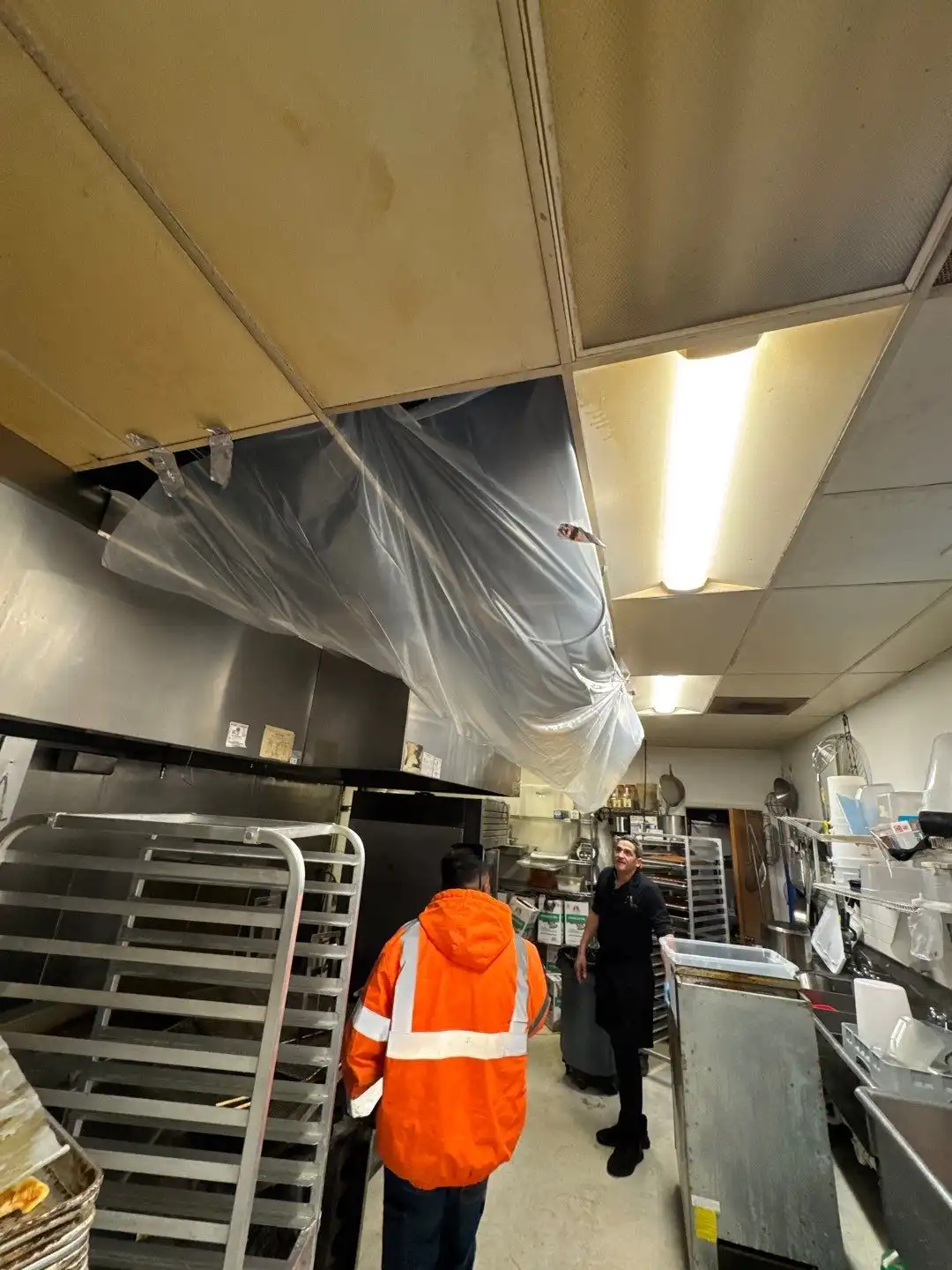
One Knightstown restaurant owner called us after two seasons of bucket and tarp life over his kitchen. He had been told by another contractor that his roof needed full replacement at $11 per square foot. When we got up there, the bigger problem was the curb flashings around his rooftop exhaust units, which had never been properly terminated. The membrane itself had eight or nine more years in it.
We did targeted flashing repairs for about $3,400 and put him on a maintenance plan. Two years later, his roof is dry and he is saving for a planned TPO replacement instead of an emergency one. Sometimes the right answer is not the install at all, which is why we always start with a real inspection. If your situation sounds closer to his, our piece on when to coat versus replace walks through that decision.